
The Saturday Test: A 6-Step Website Audit Checklist That Finds Every Leak in Your Marketing
A one-hour, six-step audit of the buyer experience
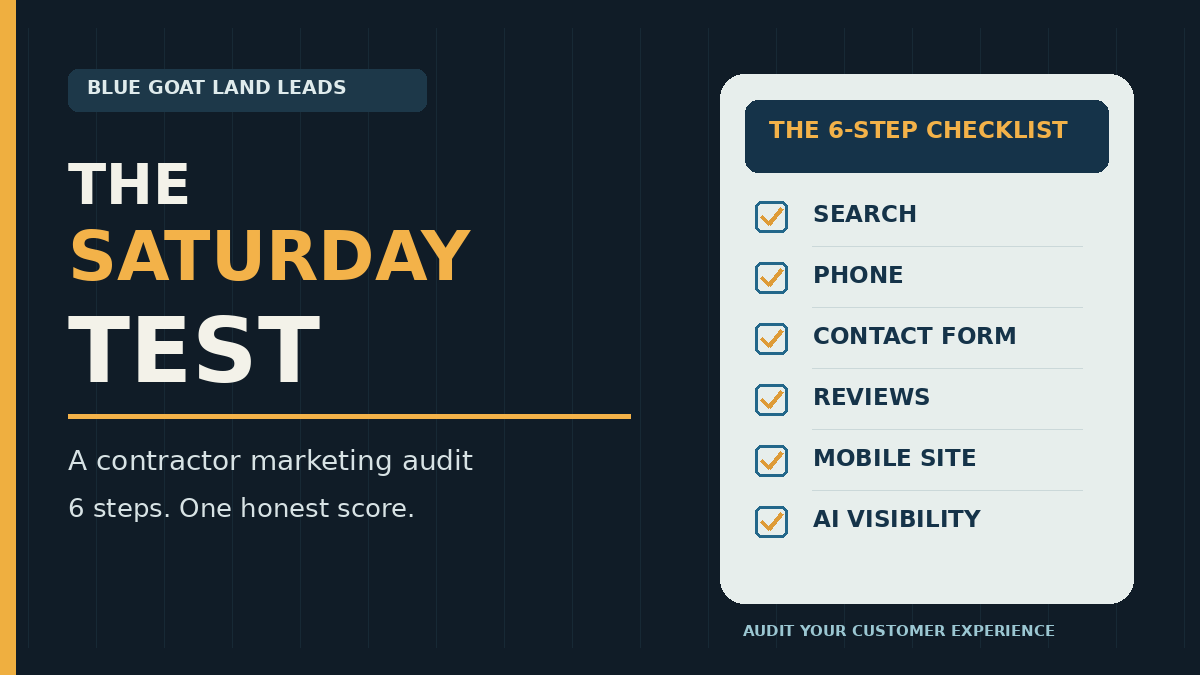
The Saturday Test is a one-hour self-audit where you act like your own customer and score six parts of your business from 0 to 10. Sixty points possible. The leaks it finds are almost never in the marketing. They're in what happens after the marketing works.
Here's where the test came from. Our founder, Josh Stockel, needed solar screens installed on his house. He searched on a Saturday afternoon and sent six local contractors a serious inquiry with his real name, phone number, project details, and photos. By Monday afternoon, exactly one had replied. A second replied five days later. Half of those six companies were paying for Google Ads to put that contact form in front of him, then not checking the inbox. If your own land clearing marketing plan feels like it isn't producing, this is usually why.
What Is the Saturday Test?
The Saturday Test is a six-step marketing audit you run on your own business, from your phone, in about an hour. You Google yourself, call your own number, submit your own contact form, read your own reviews, open your own site on mobile, and ask an AI chatbot who the best contractors in your area are. Each step gets a 0 to 10 score. The lowest score is what you fix first.
It works because it measures the thing dashboards can't: what it actually feels like to try to hire you.
The Six Steps
Grab a phone your team won't recognize. A spouse's phone or a Google Voice number works. Score honestly. Soft scores don't fix anything.
Step 1: Google yourself on a phone. Search your service plus your city, not your business name. "Forestry mulching Nashville." "Septic install Asheville." Check four spots: the paid ads, the Map Pack, page one of organic results, and an AI Overview, if one appears. Repeat for two more service-and-city combinations. Score 0 to 10.
Step 2: Call your own main number. Don't warn your team. Count the rings. Listen to how they answer: do they introduce the company by name, ask good questions about the fake job you describe, and give a clear next step? If it goes to voicemail, check whether you get a missed-call text back within seconds. Do it once on a weekday and once Saturday morning. The Saturday call matters most.
Step 3: Fill out your own contact form. Use your real phone number and a believable job. "Looking to clear about three acres for a house build, hoping to schedule for spring." Hit submit and start the clock. If nobody reaches out, either the form is broken or the inbox isn't being watched. Both are leads bleeding out daily.
Step 4: Read your five most recent Google reviews. Read them as a stranger would. Do they mention specific projects and real details, or are they generic praise? Are any of them from the last six months? Did you reply to each one? Then answer the question that counts: would you hire this contractor based on those five reviews?
Step 5: Open your website on your phone. Not a desktop. Try to find your phone number in one tap, your service list, your service area, real photos of your crew and machines instead of stock images, and a way to contact you in under 30 seconds.
Step 6: Ask an AI who the best contractors are. Open ChatGPT, Gemini, or Perplexity and ask who the best land clearing contractors in your city are. Try two or three versions. If competitors show up and you don't, that's a real gap.
Pro Tip: Do Step 2 and Step 3 on a Saturday, not a Tuesday. Weekday coverage looks fine at almost every company. Weekend coverage is where the jobs get lost, and weekends are exactly when property owners do their research.
What Your Score Means
50 to 60 — Top tier for the dirt world. Re-run in 90 days to hold it.
30 to 49 — Working, with real leaks. Fix your two lowest steps this quarter.
Under 30 — The marketing isn't the problem. Fix the single lowest step this month.
A score under 30 usually explains why a marketing budget feels wasted. The ads are working. The traffic is arriving. The experience it's arriving at is broken.
Did You Know? Harvard Business Review's research on the short life of online sales leads found that most companies respond to online inquiries far too slowly, and the chance of ever reaching a buyer drops sharply within the first hour. Hot leads stay hot for hours, not days.
Fix the Lowest Score First
Resist rebuilding everything. Pick the single worst step and fix only that one this month.
If the phone went to voicemail, turn on missed-call text-back and sort out weekend coverage. If the form got no response, test it from another device and fix the routing or assign someone to watch the inbox. If your reviews are stale, start asking for one on every completed job and reply to the reviews you already have using your Google Business Profile.
If your mobile site is slow or hard to use, that's a web fix. Google's page speed and stability targets give your developer a clear number to hit, and our breakdown of the 10 website mistakes costing you leads covers the rest. If you're invisible in search, start with getting found on Google Maps. If AI never mentions you, here's how land clearing companies show up in AI search results.
Did You Know? Half the contractors in Josh's solar screen story were paying Google for clicks while nobody watched the inbox those clicks fed. Ad spend on a broken foundation amplifies the leak as fast as the win.
Run It Again Every 90 Days
Things break quietly. Forms stop sending. Reviews go stale. A website redesign breaks the mobile layout. Contractors who run this test quarterly catch those problems in weeks instead of losing three months of leads to them.
Pro Tip: Put the next run on your calendar before you finish this one. Score it the same way and compare. A rising total is the cleanest proof your marketing money is actually doing something.
Start This Saturday
One hour, one phone, six honest scores. It's an uncomfortable hour, because you'll find things you'd rather not know. But it tells you exactly what's broken right now, which is more than any marketing report will.
Block an hour this Saturday morning and run all six steps. Write your scores down, circle the lowest one, and schedule that fix this month. If you'd rather have an outside set of eyes on it, our team runs the full audit for contractors every week. Book a free audit call and we'll walk your fix list with you, in order, starting with the leak that's costing you the most.
Frequently Asked Questions
How long does the Saturday Test take? About one hour from your kitchen table. Five of the six steps take a few minutes each, and the slowest part is waiting to see how fast someone responds to your own contact form. Score each step 0 to 10 as you go.
What is a good Saturday Test score? Anything over 50 out of 60 puts you in the top tier of dirt world contractors. Most first-time scores land between 15 and 30. Under 30 means the experience your marketing delivers people to is the problem, not the marketing.
Why run a website audit checklist on a Saturday? Weekends are when property owners research contractors, and weekends are when most contractor phone and form coverage falls apart. Testing on a Tuesday makes everything look fine. Testing Saturday morning shows you what buyers actually experience.
How often should contractors audit their own marketing? Every 90 days. Forms break, reviews go stale, staff changes, and site updates undo mobile fixes. A quarterly rhythm catches problems in weeks instead of quarters, and lets you compare scores over time.
What should I fix first if I score badly? Fix only your lowest-scoring step this month. Lead response speed and missed-call text-back are usually the fastest wins because they cost almost nothing and protect leads you already paid for. Search and AI visibility take longer.
Featured Resources
Check Our Latest Resources