
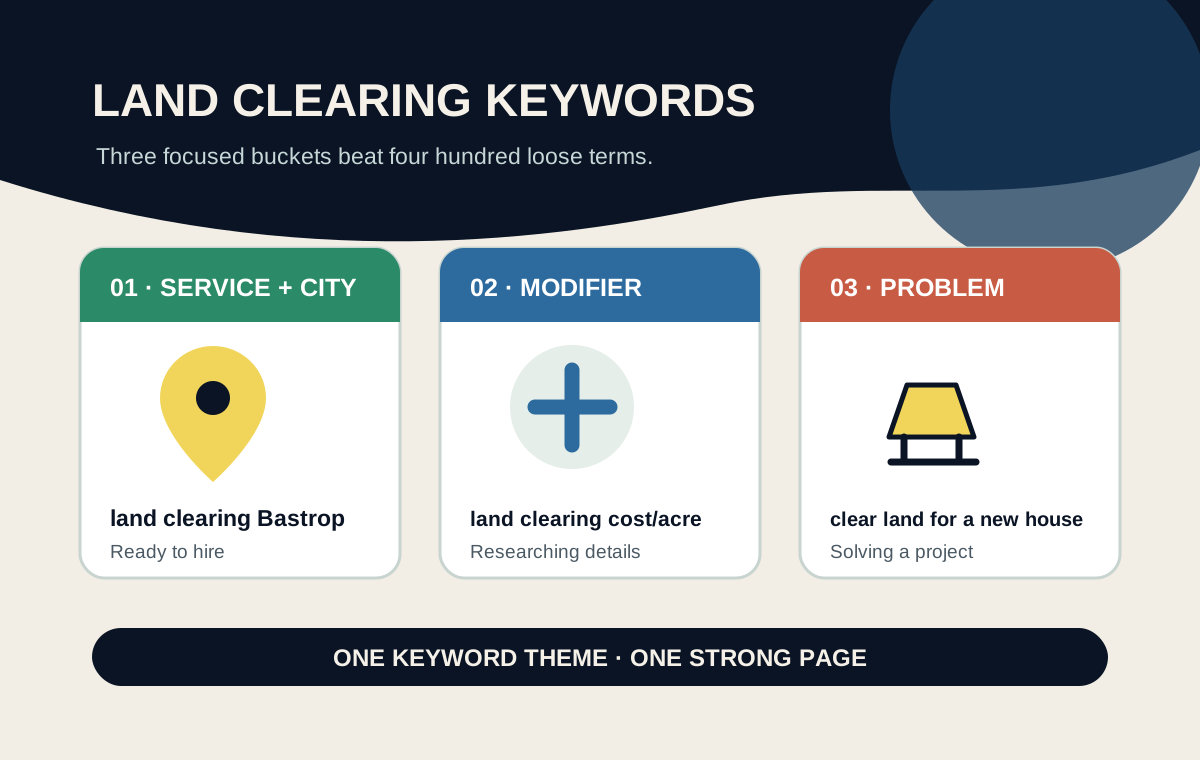
A land clearing company should target three kinds of keywords: service plus city (“land clearing Bastrop”), service plus a modifier (“land clearing cost per acre”) and problem-based searches (“clear land for a new house”). Most crews need 10 to 30 real keyword combinations, each with its own page. Not hundreds.
Owners who chase giant keyword lists usually rank for none of them. Below is how we pick keywords for dirt contractors, why fewer works better and how to turn your list into pages. It is the same starting point we use when we build SEO for land clearing and excavation companies.
What Is a Land Clearing Keyword?
A land clearing keyword is the exact phrase a property owner, builder or developer types into Google when they need your service. It is usually a service, a place and sometimes a question about cost or timing. Good keywords match how buyers talk, not how contractors talk. “Lot clearing near me” beats “vegetation management solutions” every time.
The 3 Keyword Buckets Every Dirt Contractor Needs
Josh Stockel, our founder, sorts every keyword into one of three buckets in his book, Land It in the Dirt World. Each bucket catches a different kind of buyer.
| Bucket | Example | What the buyer wants | Best page type |
|---|---|---|---|
| Service + city | land clearing Bastrop | To hire someone now | City service page |
| Service + modifier | land clearing cost per acre | Pricing or details first | Pricing page or FAQ |
| Problem-based | clear land for a new house | Help with a specific project | Blog post or project page |
Pro Tip: Put your pricing ranges on the page you build for Bucket 2. “How much does it cost” searches are some of the most common questions buyers ask, and a real range answers them better than “call for a quote.”
Bucket 1: Service + City
These are your money keywords. “Forestry mulching Nashville.” “Land clearing Columbus.” “Excavation contractor Boise.” The person typing them wants someone to call. Rank for these first.
Bucket 2: Service + Modifier
These add a word that shows the buyer is researching. “Land clearing cost per acre.” “How much does forestry mulching cost.” “Demolition contractor insurance requirements.” These buyers are not ready to call yet, but they will remember who answered their question.
Bucket 3: Problem-Based Searches
These describe the job, not the service. “Overgrown land cleared for new build.” “Food plot installation on hunting land.” “Prep acreage for a pond.” Josh calls these gold because most competitors never target them.
How Much Search Volume Is Out There?
More than most owners think. These are rough national monthly numbers Josh shares in Chapter 5 of his book. They drift over time, so treat them as a sense of scale.
| Keyword | Approx. monthly searches (US) |
|---|---|
| excavation contractor | ~21,400 |
| forestry mulching | ~17,400 |
| demolition contractor | ~15,800 |
| land clearing services | ~10,400 |
Josh notes that “land clearing services” gets much bigger once you break it into city-level searches.
Did You Know? According to Josh’s numbers, searches for “forestry mulching” grew around 50% in a single year. He calls it the biggest keyword most dirt contractors do not even target.
Why 20 Keywords Beat 400
One story from Josh’s book explains why we push for a short list. Our team inherited a client whose last ads specialist was running ads on 400 keywords. Many had nothing to do with what he sold. Others pointed at the wrong kind of buyer. His conversion rate sat around 3%. We cut the list down to the keywords that matched his real customers. Three days later, his conversion rate and lead flow had tripled.
The Same Lesson Applies to Your Website
That story came from a Google Ads account, but the lesson is the same for SEO. Josh’s rule of thumb: a forestry mulching company has maybe 10 to 20 keyword combinations that really matter, or about 30 if it runs several services. A website that chases hundreds of loose terms ends up with thin pages that do not rank for anything. Our Google Ads management for land clearing page covers ad keyword setup.
Straight From the Playbook: “Not what you think they search. What they actually search.” That is Josh Stockel in Land It in the Dirt World (Chapter 5, “SEO That Moves Calls”), on the step most contractors skip before they write a single page.
Start With Your Customers, Not a Tool
Before you open any keyword tool, run Josh’s go-to exercise: pull up your last 25 closed jobs. Which buyer type made you the most money, and where were those jobs? If your best work is house pads for builders in three counties, your keywords should say so.
How to Find Your Keywords in One Afternoon
You do not need expensive software to do this.
- List your services and your top five cities. Use the profitable work from your last 25 jobs. These become your Bucket 1 combinations.
- Type each service into Google on your phone. Watch the autocomplete suggestions drop down. Those are real searches people type.
- Check volumes in Google’s free tool. Google Keyword Planner shows estimated monthly searches for any keyword idea.
- Write down the questions customers ask on the phone. “Can you burn the brush?” “Do I need a permit?” Each one is a Bucket 2 or Bucket 3 keyword your competitors probably ignore.
- Assign every keyword to one page. One keyword theme, one page. If two pages chase the same phrase, they compete with each other.
Turn Your Keywords Into Pages Google Trusts
A keyword list does nothing until it lives on a page.
One Page Per Service, Per City
Build a dedicated page for each service in each city that matters most, like “Forestry Mulching in Franklin, TN.” Start with your top five cities and add more as you grow. Our beginner’s guide to local SEO for dirt work companies shows how service-area pages fit with your Google Business Profile.
Write Each Page Like a Person Will Read It
Use the keyword in your headline and naturally in the copy, then write the page the way you would explain the job to a customer in your driveway. Real photos, real details about that area and a clear way to call. Google’s guidance on helpful, people-first content says the same thing: content made mainly to attract search traffic is a warning sign.
Do not clone fifty city pages and swap the town name. Josh warns that Google treats those as doorway pages and pushes them down.
Time Seasonal Keywords Early
Food plot and hunting lane searches spike in late summer. Josh’s advice is to publish seasonal pages three to six months before the season hits, so Google has time to find and rank them.
Wrap-Up
The best land clearing keywords are not the biggest list. They are a short set of service and city phrases, the cost and timing questions buyers ask and the specific jobs your competitors ignore, each matched to one strong page.
Want to know which keywords you already rank for and which ones you are missing? Book a free strategy call with Blue Goat Land Leads. Or start with our land clearing marketing guide, then run the Saturday Test marketing audit this weekend and see where you show up today.
Frequently Asked Questions
What are the best keywords for a land clearing company?
The best keywords pair your service with the cities you work in, like “land clearing [city]” or “forestry mulching [city].” Add cost and timing searches like “land clearing cost per acre,” plus problem-based searches like “clear land for a new house.”
How many keywords should a land clearing website target?
Most land clearing companies need about 10 to 20 keyword combinations, or around 30 if they run several services. Each one should have its own page. A short, focused list beats hundreds of loose terms.
How do I find keywords for my land clearing business?
Start with your most profitable jobs and the cities they came from. Then check Google autocomplete, look up volumes in Google Keyword Planner and write down the questions customers ask you on the phone.
Should I make a separate page for every city I serve?
Yes, for your most important cities, as long as each page has real, local content. Start with your top five cities and expand from there. Copy-paste pages that only swap the town name can hurt your rankings.